Connecting People,
Purpose & Capital

Earth-Aligned Initiatives
Uncompromising Standards

Intent Execution

Most impact initiatives fail long before scale, not because the idea is wrong, but because structure, readiness, and accountability are missing. Good intentions stall. Accountability blurs. Capital hesitates.

Terravive Group is designed to address those failure points while the stakes are still low.

System Governance in Practice

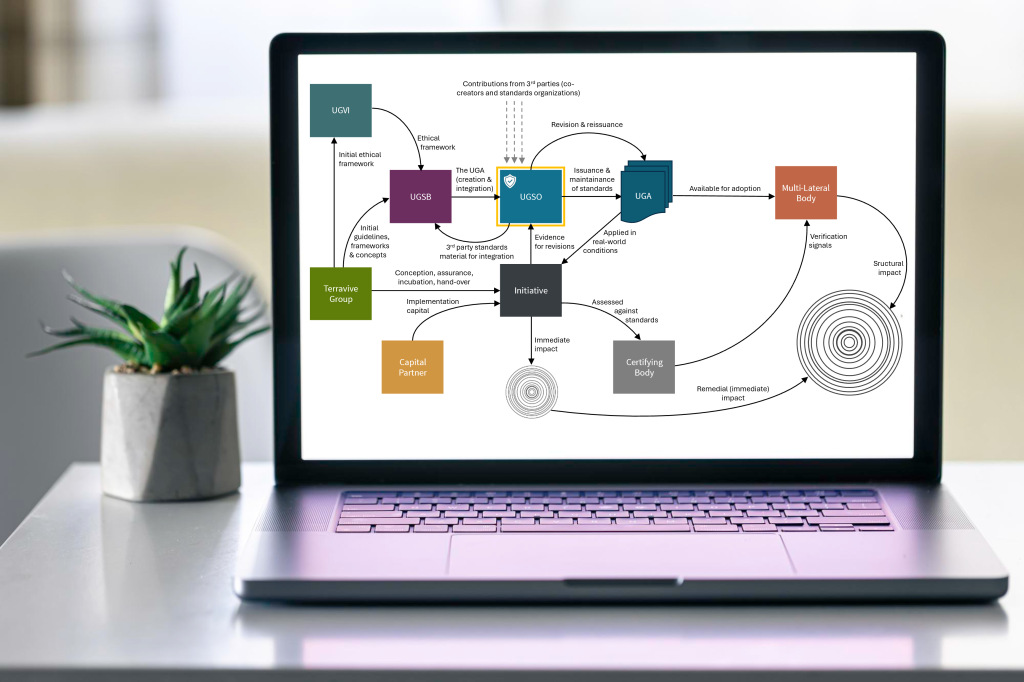
System governance is structured as a closed loop linking standards, capability development, and enforcement under real operating conditions.

Standards →

Standards stack defining normative values, constraints, and rules applied by the decision framework

Capability →

Programmes that develop the institutional and human competence required to apply structured governance under coordination pressure and long-horizon complexity

Enforcement

Decision architecture specifying constraints, traceability, and collective reasoning designed to preserve system integrity by aligning intent, rules, normative values, and execution

Bridging Gaps

Systemic breaks that undermine regeneration

The Capital
Gap

The Alignment Gap

The Continuity Gap

Misaligned Funding Flows

Lack of Integrated Action

Short Cycles, No Staying Power

Long-horizon infrastructure often stalls not because funding is absent, but because financial models are built for short cycles and linear returns. Capital struggles to engage with initiatives requiring lifecycle clarity, temporal depth, and system-level value recognition.

Projects fragment when stakeholders operate without shared definitions, responsibilities, or timelines. Inconsistent governance and ad hoc coordination increase friction, diffuse accountability, and slow execution even when funding and capability exist.

Performance degrades when responsibility and oversight weaken after deployment. Short-term delivery structures fail to sustain monitoring, maintenance, and accountability, allowing gains to reverse and long-term outcomes to erode.

(*) Learn more about the 3-Gap Lens as a system-governance diagnostic tool and gain access to extended material at www.ugso.org.

System-Level Design

Mapping out the conditions for Structural Persistence

Most real-world failures are not caused by a lack of technology or capital, but by the absence of shared structures that enable alignment across actors, predictable outcomes, and long-term continuity. Explore the UGC Ecosystem at UGSO.org to learn how these conditions are established.