
The Unified Governance Continuum (UGC) is an ecosystem of organizations that work together to create and launch impact initiatives, and to develop the standards that allow this work to continue when funding dries out or changes, leadership turns over, or political priorities shift.
The ecosystem brings together different kinds of actors with distinct roles. These include standards organizations and other co-creators who design and refine governance standards; capital partners who support initiatives through different phases of risk and scale; changemakers and operators who carry initiatives into the real world; and values-based institutions that help anchor standards in ethical, social, and ecological priorities.
By working within a shared environment, these actors can contribute without needing to own or control the whole system. What is developed in one initiative can be reused, adapted, and carried forward by others. This allows learning, standards, and responsibility to persist even as individual projects end or transition.
Beyond individual initiatives, the UGC also advances standards in systems governance, with the aim of supporting more consistent and coordinated approaches to standards development at multilateral level.
Across impact, sustainability, and systems-change work, the same breakdown keeps recurring. Initiatives start with urgency and commitment, make real progress, and then stall or fragment as conditions change. Funding dries out or shifts. Key people move on. Political priorities turn. Governance arrangements that worked early on stop holding under pressure.
When this happens, work that should continue does not. Knowledge is lost between initiatives. Standards are reinterpreted or quietly abandoned. Each new project is forced to rebuild structures that already existed elsewhere, wasting time, trust, and capital.
The UGC exists because these failures are not exceptional. They are structural. Without a shared environment that can hold standards, roles, and commitments across change, even well-designed initiatives struggle to survive long enough to compound their impact.
The UGC originated from Terravive Group’s direct experience with these failure modes. Repeatedly, initiatives that were viable in practice were undermined by the absence of continuity at system level. What was missing was not execution capacity, but a way for governance logic and standards to persist beyond any single initiative or organization.
Terravive Group initiated the UGC to address this gap. The intent was to create an operating environment where initiatives could be launched, tested, handed over, and renewed without resetting the underlying rules each time conditions changed.
While the UGC is designed to function independently of any one actor over time, Terravive Group currently carries responsibility for advancing it, maintaining coherence as it evolves, and ensuring that what is built remains usable, transferable, and grounded in real-world application.
The Unified Governance Continuum (UGC) is the overarching system within which initiatives, institutions, and governance functions are conceived, developed, and ultimately handed off. It provides the long-term continuity for values, standards, operating logic, and institutional roles, while allowing individual entities to emerge, operate, and transition without collapsing the system as a whole.
Unified Governance Systems Organization (UGSO) operates as an institutional steward within the UGC. Its role is architectural rather than operational: to maintain the coherence, lineage, and long-term integrity of the UGC framework as it is applied across initiatives, contributors, and domains.
Terravive Group initiates and advances impact initiatives, develops the underlying governance standards, and fulfils the role of interim standards originator. UGSO does not execute initiatives or originate standards; it stewards the UGC governance architecture and ensures that standards, once developed and applied, remain structurally consistent, interoperable, and fit for reuse over time.
Co-creators participate directly by applying, testing, and extending standards in real-world contexts. This separation of roles is deliberate and structural, allowing innovation, co-creation, and initiative delivery to proceed without compromising architectural continuity or governance integrity.
The UGC is intentionally decentralized. It does not depend on a single authority, owner, or execution body to function. Instead, it provides a shared governance environment in which different actors can participate without needing to control the whole system.
Initiatives act as execution vehicles. Standards organizations and co-creators develop and refine standards. Capital partners support work across different phases of risk and scale. Changemakers and operators carry initiatives into practice. Values-based institutions help anchor standards in ethical, social, and ecological priorities.
This separation of roles is deliberate. It allows experimentation, delivery, and co-creation to proceed while keeping continuity at system level. What matters is not control, but the ability for learning, standards, and responsibility to carry forward even as individual projects conclude, transition, or give way to new ones.
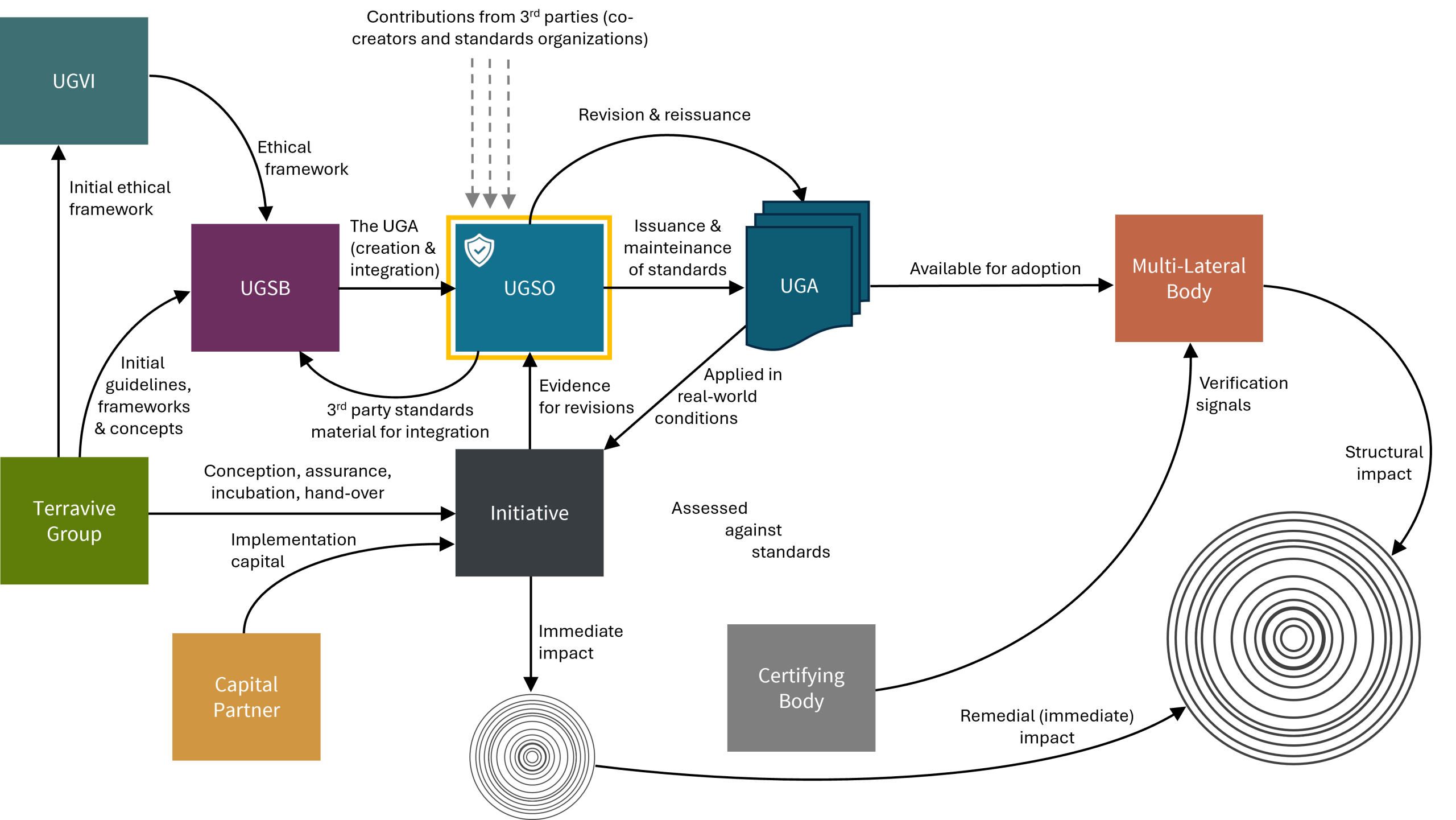
This diagram illustrates the relationship between execution, initiatives, and governance within the Unified Governance Continuum. A detailed explanation of the structure, roles, and stewardship model is maintained by UGSO and is available at the following link to the UGSO.org website:

128 City Road
London EC1V 2NX
United Kingdom
Copyright © Terravive Group 2025. All Rights Reserved.
Companies House reg. no 16233378